PRP for Knee Osteoarthritis: 2026 Evidence, Dosage & Advice
One-Minute Summary
Key Conclusions:
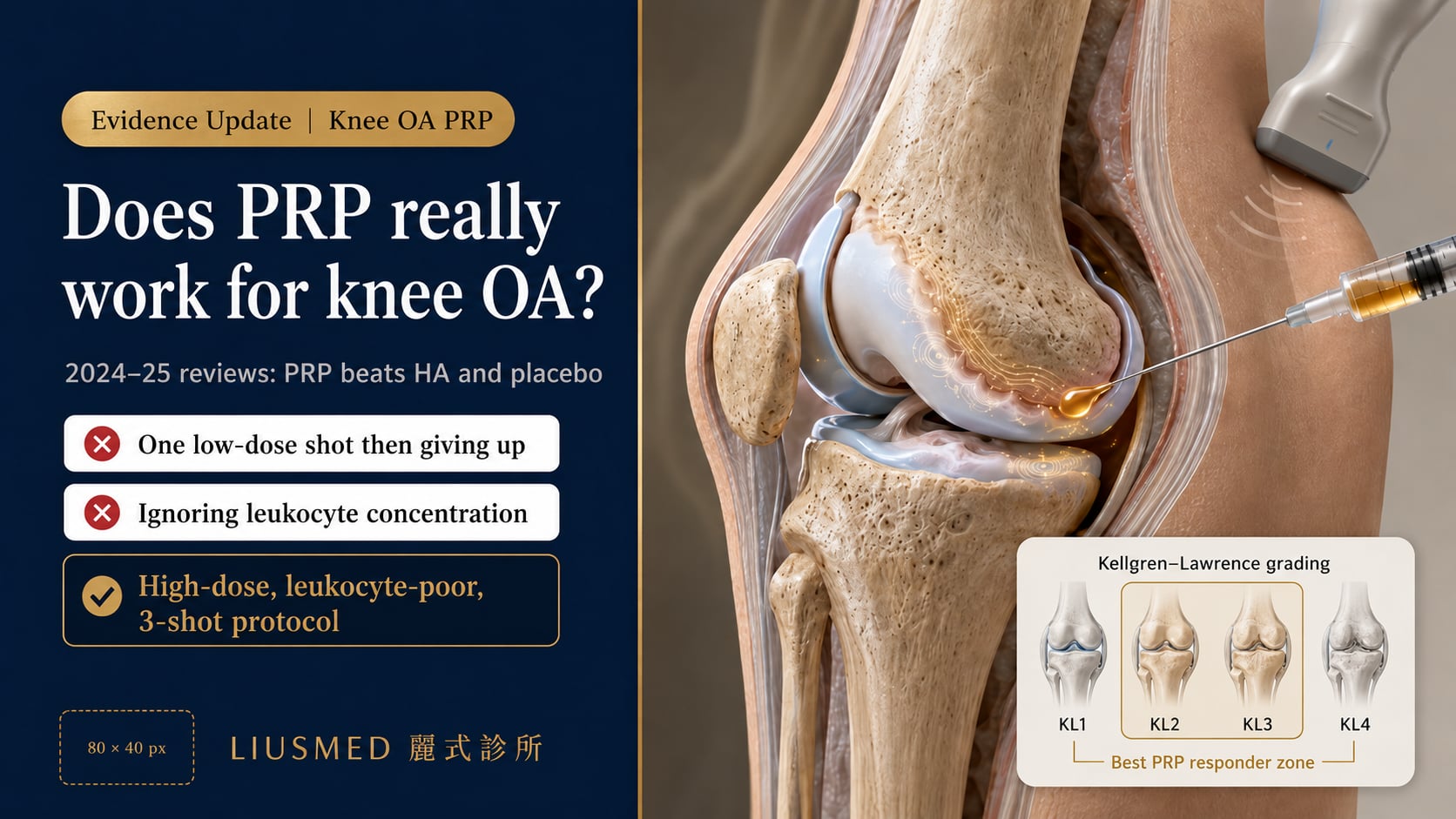
- Multiple 2024–2025 systematic reviews confirm PRP (Platelet-Rich Plasma — concentrate of your own blood platelets rich in growth factors) significantly outperforms HA (hyaluronic acid — sugar molecule naturally in skin/joint, holds water) and placebo, especially over 6–12 months.
- 2025 dosage Network Meta-Analysis (NMA — indirect multi-treatment comparison): high-dose PRP (PRP3, 3× standard platelet concentration) yields the best VAS (Visual Analog Scale — 0–10 line scale for pain rating) pain and WOMAC (Western Ontario and McMaster Universities Osteoarthritis Index — knee/hip OA pain & function scale) function improvement.
- Leukocyte concentration matters: LP-PRP (Leukocyte-Poor PRP — PRP filtered to remove white blood cells, gentler inflammation) generally outperforms leukocyte-rich.
- Clinical recommendation: Kellgren-Lawrence (KL) (OA X-ray severity grade 0–4) II–III patients respond best; KL IV severe disease shows limited response.
- PRP serves well as a surgery-deferral strategy — highly valuable for middle-aged patients reluctant or not yet ready for knee replacement.
The Knee OA Treatment Ladder
Osteoarthritis (OA — wear-and-tear joint disease) treatment generally follows a stepwise approach by severity:
| Stage | KL Grade | Standard Treatment | PRP Role |
|---|---|---|---|
| Early | I–II | Weight management, rehab, oral NSAIDs | Preventive intervention, delay degeneration |
| Mid | II–III | + HA, corticosteroid injection | First-choice adjunct, outperforms HA |
| Late | III–IV | Consider knee replacement | Defer surgery, symptom relief |
| End-stage | IV | Knee replacement primary | Limited response; consider post-op adjunct |
Why PRP Has a Theoretical Basis for OA
OA pathology is not just "cartilage wear" — it is whole-joint microenvironment inflammation and imbalance:
- Synovitis
- Cartilage matrix degradation
- Subchondral bone remodeling
- Synovial fluid biochemical abnormality
PRP releases high-concentration growth factors targeting these mechanisms:
- TGF-β (Transforming Growth Factor Beta — fibrosis & repair signal): chondrocyte proliferation, suppression of IL-1β (Interleukin-1 beta / Interleukin-6) inflammation
- PDGF (Platelet-Derived Growth Factor — platelet-released cell growth signal): stimulates extracellular matrix synthesis
- IGF-1 (Insulin-like Growth Factor 1 — growth/repair signal molecule): promotes type II collagen synthesis
- VEGF (Vascular Endothelial Growth Factor — new blood vessel signal): improves subchondral bone perfusion
2024–2025 Latest Evidence
Major Systematic Reviews
A 2024 Annals of Medicine and Surgery comparative effectiveness review of intra-articular treatments concluded:
PRP outperformed all comparators (HA, corticosteroid, placebo) on three key indicators: success rate, achievement of minimal clinically important difference (MCID — smallest treatment improvement patient notices), and rates of avoiding re-intervention.
Statistical Significance
The 2025 PLOS One PRP-vs-HA meta-analysis:
- VAS pain: PRP 6-month improvement significantly greater than HA (p<0.05)
- WOMAC function: significant difference maintained at 12 months
- Adverse events: comparable, both mild and transient
Dose-Response Relationship
The 2025 dosage Network Meta-Analysis ranked:
| Dose Type | Platelet Concentration | Efficacy Rank |
|---|---|---|
| PRP3 (high-dose) | 5–7× baseline | Best |
| PRP2 | 3–5× baseline | Second |
| PRP1 (standard) | 2–3× baseline | Effective but weaker |
| Below 1.5× baseline | — | Near-placebo |
Key insight: "PRP works for everyone" oversimplifies. Platelet concentration, number of injections, and leukocyte ratio all significantly affect clinical outcome.
Best Responders
Strong Candidates
- KL II–III (moderate) — substantive cartilage to preserve
- Pain affecting daily activity but not yet disabling
- Not suitable or unwilling for joint replacement
- Limited or diminishing HA response
- Age 45–65, high activity demand
Poor-Response Scenarios
- KL IV severe (cartilage nearly absent)
- Severe obesity (BMI >35) — mechanical stress overrides biological effect
- Mainly mechanical symptoms (locking, catching) — may need surgery
- Strong inflammatory arthritis (rheumatoid, etc.) — primary disease must be addressed
Protocol Design: Frequency and Intervals
Common protocols:
Three-Shot Protocol
- Every 2–4 weeks × 3 sessions
- Most common; the basis of most studies
- Peak effect at month 6
Single-Dose Intensified
- Single high-dose (PRP3) injection
- Effective in select KL II–III patients
- Re-evaluate at 6 months for additional dose
Maintenance
- Initial 3-shot then booster every 6–12 months
- Suits long-term management plans
PRP + HA Combination: 1 + 1 > 2?
See related article on PRP + HA combined knee strategy.
Briefly:
- PRP + HA outperforms HA alone (high evidence)
- PRP + HA vs PRP alone: evidence mixed; some studies favor combination especially after 6–12 months
- Clinical practice: many physicians use "PRP first, then HA at 4–6 weeks" sequential strategy
Side Effects and Risks
Autologous-blood PRP has high safety:
Common:
- 24–72 hour post-injection joint swelling and pain (initial growth-factor inflammation)
- Transient activity restriction
Rare:
- Infection (with sterile technique <0.1%)
- Brief symptom worsening
Contraindications:
- Active infection
- Severe anemia (Hb <10 g/dL)
- Platelet function disorders
- Antiplatelet medication (consult primary physician)
- Uncontrolled malignancy
PRP Quality: Critical to Outcomes
Not all "PRP" is equal. Verify:
- Centrifugation system: standardized, reproducible closed system?
- Platelet concentration measurement: validated each session?
- Leukocyte ratio: knee PRP prefers leukocyte-poor
- Freshness: blood draw to injection within 30–60 minutes
- Injection site: ultrasound-guided beats blind injection
Key insight: Many "PRP failures" are preparation or injection-technique problems, not PRP ineffectiveness. Choosing a clinic with full process standardization is essential.
When to Consider Knee Replacement
PRP is not a panacea. These should prompt orthopedic surgical consultation:
- Strict conservative care for 6–12 months still leaves severe pain affecting life
- KL IV severe degeneration
- Mechanical locking, deformity
- Recurrent joint effusion
PRP's role is to defer or avoid surgery — not replace surgery when truly needed.
Common questions
Does PRP actually work for knee osteoarthritis, and is it really better than hyaluronic acid?
Looking at the systematic reviews from the last couple of years, PRP does tend to improve pain and function more than hyaluronic acid and placebo, and the difference shows up most clearly in the 6-to-12-month window after treatment. That said, it doesn't work the same for everyone — platelet concentration, how many injections you get, and the leukocyte ratio all shift the result, so it really comes down to your individual situation.
Is my level of knee degeneration suitable for PRP?
The people who tend to respond well are KL grade II–III, moderate degeneration where there's still real cartilage to preserve, usually around 45 to 65 with an active lifestyle. If the cartilage is nearly gone at KL IV, or if there's severe obesity or mainly mechanical problems like locking and catching, the effect tends to be limited, and that's something we'd want to assess in person before deciding.
How many PRP injections do I need, and when will I feel the effect?
The common approach is one injection every 2 to 4 weeks for a total of three, which is how most of the studies are designed, with the effect usually peaking around month 6. Some moderate-degeneration patients go with a single higher-concentration dose and then reassess at six months. If you want to hold the result longer, a booster every 6 to 12 months is an option.
Is PRP safe, and what should I expect afterwards?
PRP is prepared from your own blood, so the safety profile is good. The common thing is joint swelling and soreness in the first 24 to 72 hours — that's the early growth-factor inflammation, it settles over a few days, and you'll have some limited movement during that time. Infection is uncommon, under 0.1% with sterile technique. If you have an active infection, severe anemia, or you're on antiplatelet medication, we'd talk that through first.
If I get PRP, does that mean I won't need a knee replacement?
It's not quite that. PRP's role is more about deferring surgery or helping you avoid getting to that point — it isn't a substitute for surgery when surgery is genuinely needed. If you've done six to twelve months of conservative care and still have severe pain affecting daily life, or you're already at KL IV with clear deformity, that's when you'd sit down with an orthopedic surgeon to discuss the surgical options.
Conclusion: PRP Is the "Mid-Stage Weapon" for Knee OA
For moderate degeneration with active patients, PRP has progressed from "experimental therapy" 5 years ago to "mainstream non-surgical option" in 2026. The latest evidence clearly shows:
- Overall superiority to HA
- Higher-dose and leukocyte-poor formulations are better
- Excellent surgery-deferral strategy
But PRP is not a miracle, nor for everyone. Professional evaluation, realistic expectations, and standardized preparation are the three success factors.
For evaluation of knee PRP suitability, see our joint injection regenerative service or book a consultation.
Medical References
- Comparative effectiveness of intra-articular therapies in knee OA. Annals of Medicine and Surgery. 2024.
- Efficacy and safety of intra-articular PRP versus sodium hyaluronate. PLOS One. 2025.
- Comparative efficacy of different doses of PRP for knee OA: network meta-analysis. PubMed PMID (PubMed Identifier): 40022138. 2025.
- Comprehensive Summary of Meta-Analyses on PRP for Knee OA. Military Medicine. 2024.
- PRP Injections for Knee OA: Influence of Platelet Concentration: Meta-analysis. Bensa A, et al. 2025.
- Corticosteroids, HA, PRP, and Cell-Based Therapies for Knee OA: Systematic Review. 2025.
Editorial review: Reviewed by Dr. Ta-Ju Liu. Last reviewed 2026-04-27.
Related Services

Specialties
Credentials
- Kaohsiung Medical University, School of Medicine
- Attending Physician, Dermatology, Kaohsiung Chang Gung Memorial Hospital
- Attending Physician, Aesthetic Center, Kaohsiung Chang Gung Memorial Hospital
- Visiting Physician, Dermatology, Xiamen Chang Gung Hospital
- Visiting Physician, Aesthetic Center, Xiamen Chang Gung Hospital
"For every surgery, I strive to achieve a good outcome through a small incision and refined technique. Minimally invasive surgery is not just a technique — it's a commitment of respect to every patient."
Want to learn more?
Schedule a consultation for professional evaluation and advice